●
Full report (PDF)
The complete 16-page report: the hub concept and its three tests, the five raw materials, a chapter on each hub, how the hubs interlock, what deliberately falls outside the scheme, and a glossary.
Download the report Inner Planets Foundation
everything a resource
How a Martian settlement makes almost everything from five raw materials. A Foundation research report, written for the technically literate non-chemist.
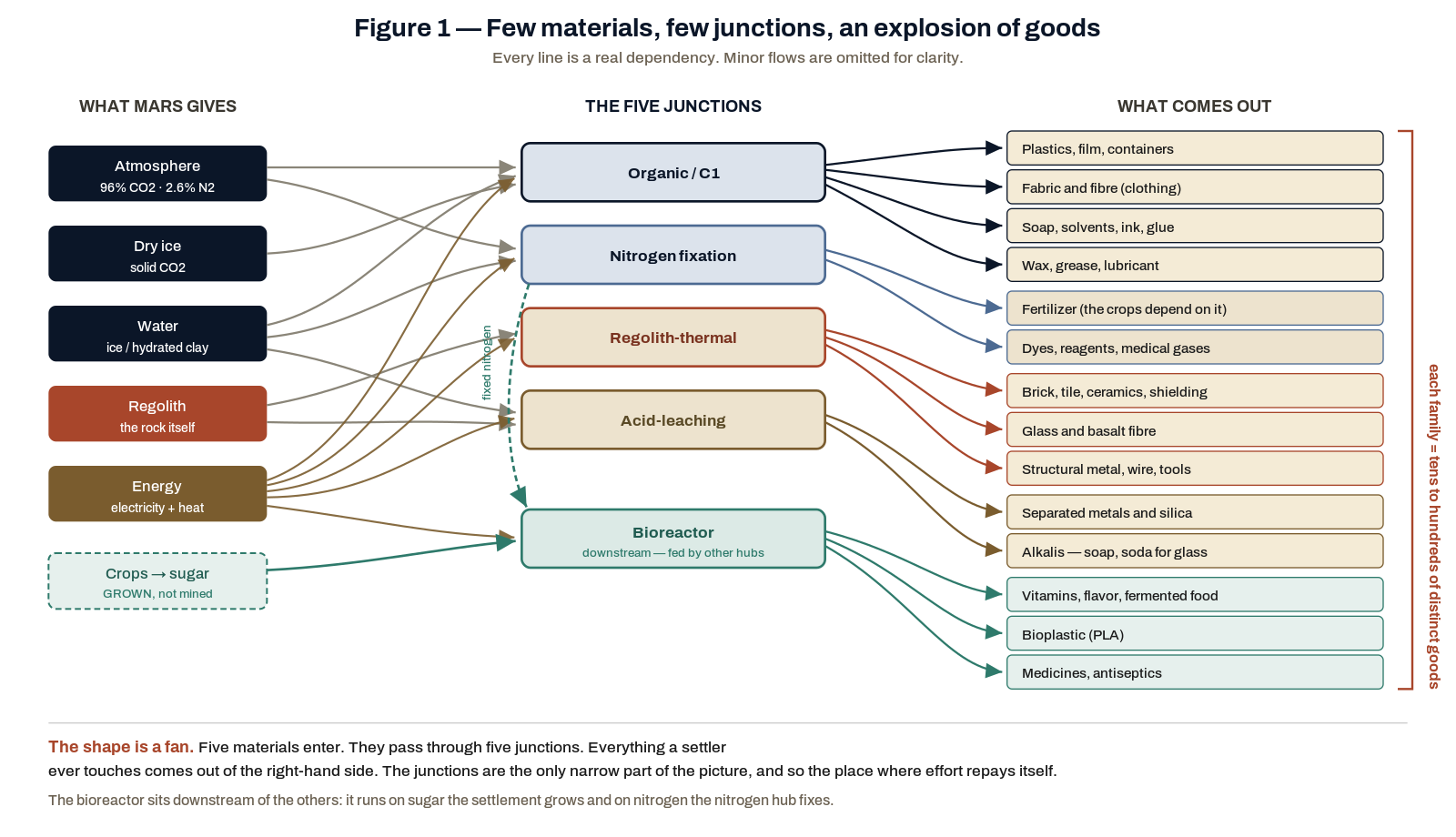
A settlement on Mars needs an enormous variety of things: soap, clothing, gaskets, glue, ink, fertilizer, antiseptic, lubricant, window glass, wire, brick. Shipping them is ruinously expensive, and Mars offers a very short list of raw materials to make them from — rock, air, water ice, dry ice, and sunlight. The question is not what a settlement needs. It is by what path a short list of raw materials becomes a long list of finished goods.
The chemical dependencies fan out. Five materials enter, pass through a small number of junctions, and from those junctions the whole product list emerges. This report calls those junctions conversion hubs, gives three tests for what earns the name, and finds that on Mars the answer is five: the organic (C1) hub, nitrogen fixation, the bioreactor, the regolith-thermal hub, and acid leaching.
The report defines a set of process maturities: paper, lab-demonstrated, simulant-demonstrated, flight-proven, and demonstrated on Mars. Exactly one process in the report has reached the last rung. The organic hub, on which nearly every plastic, fabric and solvent depends, sits at the first: the chemistry is not in doubt, but no one has run the integrated train on Martian feedstocks.
The hubs are not independent — the waste of one is the feedstock of another, and the carbon loop between the organic and regolith-thermal hubs closes on itself.
The complete 16-page report: the hub concept and its three tests, the five raw materials, a chapter on each hub, how the hubs interlock, what deliberately falls outside the scheme, and a glossary.
Download the reportReaders who wish to discuss the analysis, to question or correct it, or to learn more about the research behind it are invited to write to info@innerplanets.foundation, or to contact a Director of the Foundation. Correspondence from specialists in any of the five hub chemistries — and particularly from those who think a conclusion here is wrong — is welcome.
Cite as: Inner Planets Foundation (2026). Conversion Hubs: How a Martian Settlement Makes Almost Everything From Five Raw Materials. innerplanets.foundation/reports/conversion-hubs.html
Updated October 14, 2026: the report PDF carries the Foundation’s updated wordmark on its cover and restores the table of contents, which was blank in the September edition. The September 26 edition named the publisher as Inner Planets Foundation, the registered assumed business name of Inner Planets Terraforming Foundation Corporation, and made one minor wording revision in Section 5.3. The analysis is unchanged.