●
Full report (PDF)
The complete second-edition report (19 pp): the seven instruments, the four streams, the function-by-source map, the funding gaps, and the per-stream methodology. Download the report.
 Inner Planets Terraforming Foundation
everything a resource
Inner Planets Terraforming Foundation
everything a resource
An open census of funding streams for space colonization, 2016–2026. A Foundation research report — published with its complete dataset and analysis code.
Ask who is planning for the human settlement of space and the answers come easily. Ask who is funding that planning — with actual dollars, to actual researchers, on the actual problems a settlement would face — and no census existed. This report is an attempt at one. It combines seven instruments: the full IRS registry of 1.97 million tax-exempt organizations, the federal award record for NASA and DARPA, the NSF award database, program inventories of NASA, ESA, and DARPA, a classified inventory of university centers, a verified review of corporate and founder philanthropy, and — in the second edition — grantee-level grant line items from IRS e-file XML for 63 targeted funders.
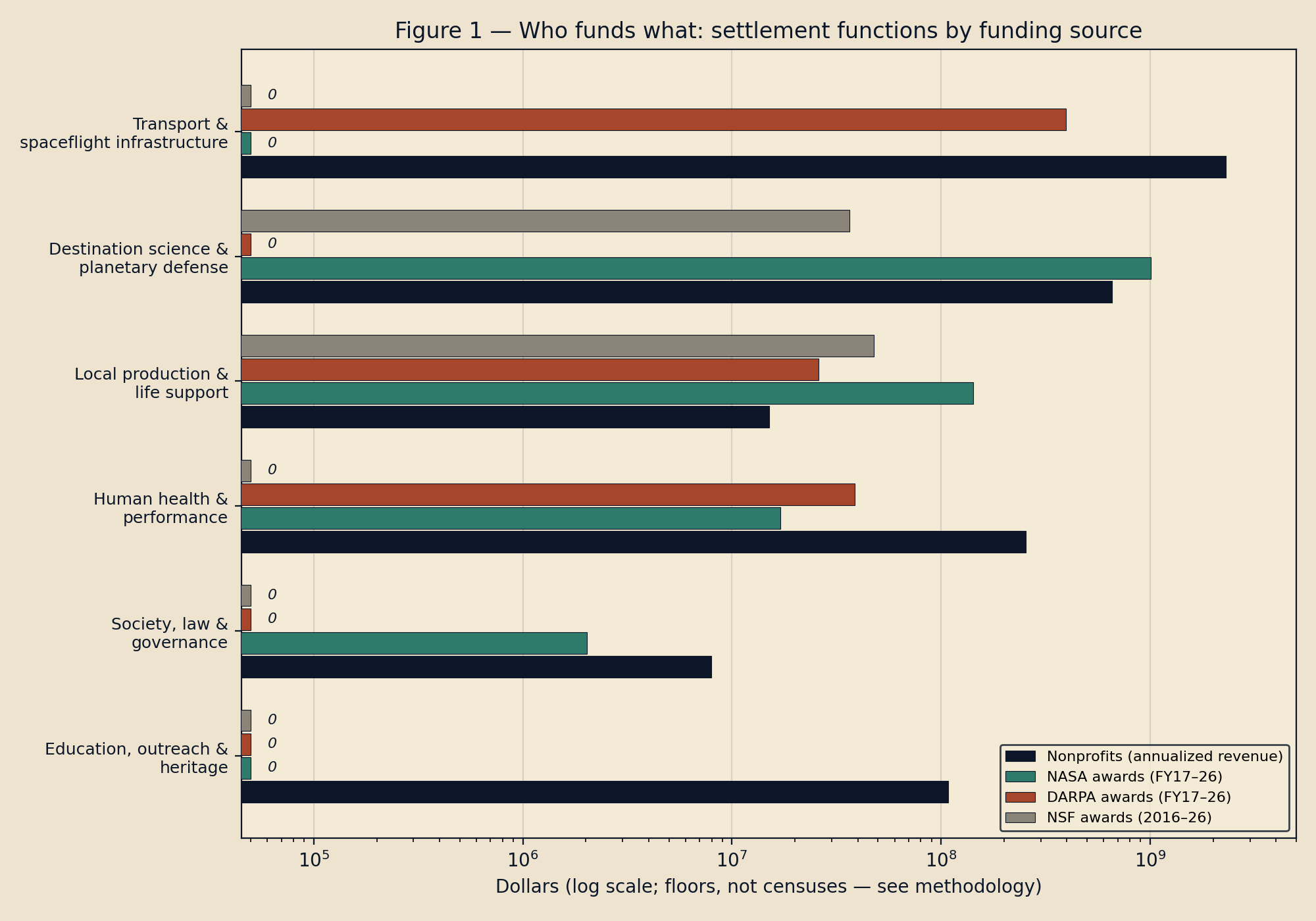
Two findings organize the report. The money is real and large — several billion dollars a year across the measurable streams — but concentrated almost entirely in hardware, biology, and destination science. And the layer of the problem that concerns how settlers would actually live together — who owns what, what serves as money, how rules are made and enforced as a community grows — receives almost nothing, from any stream, anywhere: about $10 million a year of nonprofit revenue (a third of it the young digital-community-governance field), $2 million of NASA awards across a decade, zero at DARPA and NSF — and, measured from actual grant line items in this second edition, about $1.8 million of identifiable external grant funding, through three funders.
Updated July 12, 2026 (second edition): a follow-up study added the grant-line-item instrument, promoted two topics into the census (digital-community governance; expedition training), documented two further registry-invisibility mechanisms (donor-advised-fund pass-through; non-U.S. domicile), and advanced the data release to v1.1 with a changelog. No first-edition finding was contradicted. First-edition data is preserved in the release archive.
Interest disclosure: the Foundation conducts research within the largest funding gap this report identifies. That is why we searched hard enough to find it — and why every number in the report ships with the data and code to check us. Corrections are invited.
The complete second-edition report (19 pp): the seven instruments, the four streams, the function-by-source map, the funding gaps, and the per-stream methodology. Download the report.
The census, the lopsided map, the empty governance row, and the corporate finding — in one page. Download the summary.
Eleven tables with a manifest and changelog (v1.1): the function×source matrix, all 2,562 matched organizations, matched federal awards, the new funder-to-grantee grant line items, trends, and the topic key. Every number in the report can be recomputed from these files. Download the data.
Cite as: Inner Planets Terraforming Foundation (2026). Who Funds the Settlement of Space? An Open Census of Funding Streams for Space Colonization, 2016–2026. innerplanets.foundation/reports/who-funds-the-settlement-of-space.html